
My Spouse Returned to Brazil and Disappeared. Can I Still Get Divorced?
You moved on with your life. Your marriage didn't.
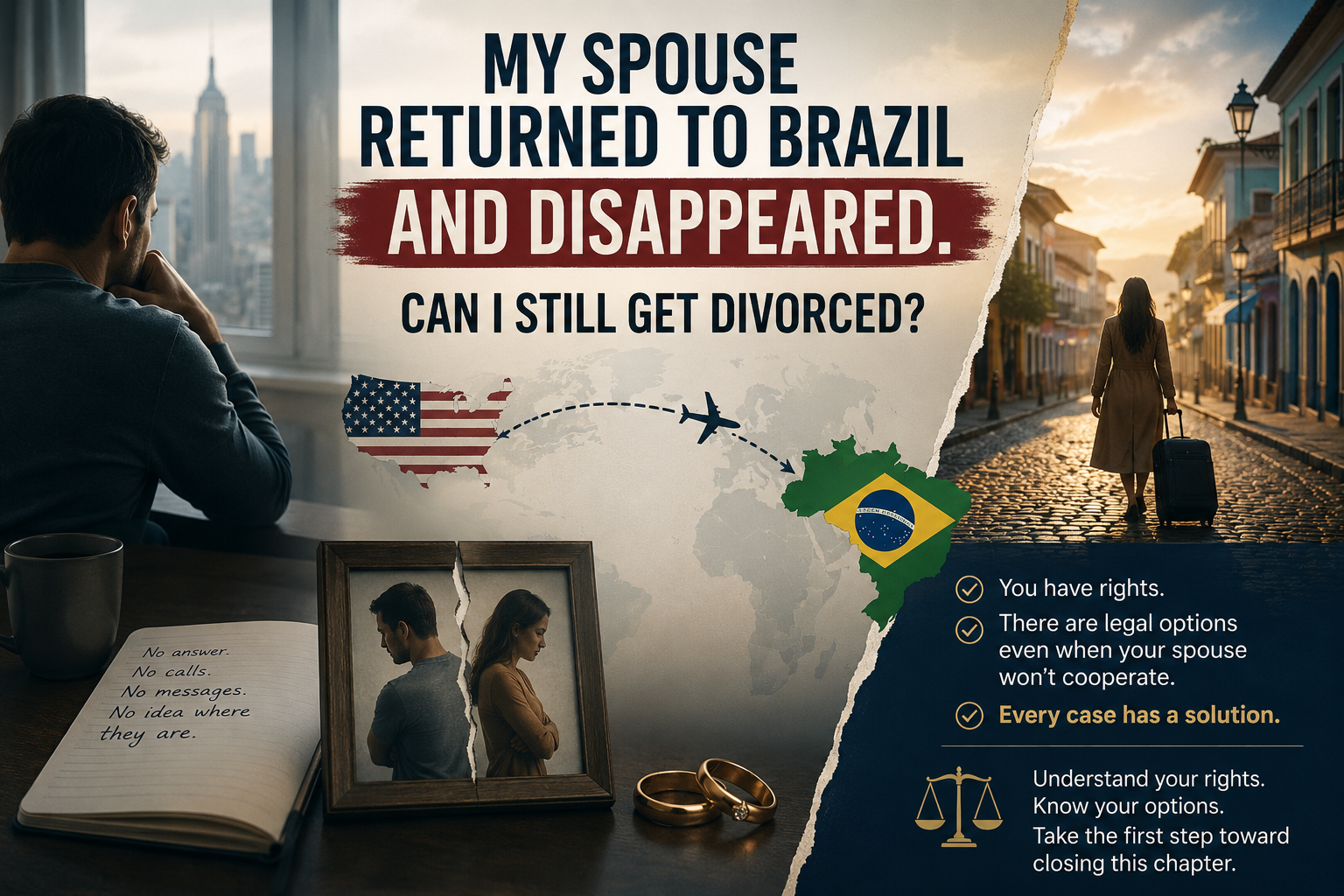
At first, most people think the situation is temporary.
Maybe they're upset; Maybe they need space; Maybe they'll answer next week.
Then weeks become months; Months become years.
The phone calls stop; The messages go unanswered; Social media accounts disappear.
Family members stop providing information.
And suddenly, you find yourself asking a question you never expected:
"How can I get divorced if I don't even know where my spouse is?"
If you're living in the United States and your husband or wife returned to Brazil and disappeared from your life, you're not alone.
In fact, this situation is far more common than most people realize.
Know that, many people continue building their lives after a separation.
Because they focus on work, raise children, buy a home... they start planning for the future.
Yet legally, they remain married, and that can create unexpected problems.
Questions begin to surface:
- Can I remarry?
- What happens if I pass away while still legally married?
- Can my spouse claim part of my assets?
- What if I want to buy property?
- What if I have children from a new relationship?
- What rights does my spouse still have?
- Do I need my spouse's permission to get divorced?
The uncertainty can be exhausting.
Many people spend years postponing a solution because they believe divorce is impossible without the other person's cooperation.
That is not always true.
"I Don't Even Know Where They Are"
This is one of the most common concerns we hear. Some people know their spouse is somewhere in Brazil but have no address, others have completely lost contact.
Some haven't spoken to their spouse in five, ten, or even fifteen years, and the natural assumption is that nothing can be done. But Brazilian law provides procedures for situations where a spouse cannot be located or refuses to participate.
The specific path depends on the facts of each case, and that is exactly why understanding your options matters.
A divorce involving someone who lives in another country is rarely just about ending a marriage.
There may be:
- Children involved.
- Child support concerns.
- Property in Brazil.
- Property in the United States.
- Joint debts.
- Inheritance implications.
What appears to be a simple divorce can quickly become much more complex if important issues are overlooked. This is why generic answers found online are often not enough. Two people may have very similar stories but require completely different legal strategies.
One of the biggest sources of stress is not knowing what comes next.
People often imagine the worst:
- "Will I need to travel to Brazil?"
- "Will this take years?"
- "Will I ever find my spouse?"
- "What if they refuse to cooperate?"
- "What if they intentionally avoid being served?"
The reality is that many of these questions have answers. And while every case is different, having a clear understanding of the available procedures can transform a situation that feels overwhelming into one that feels manageable.
In our experience, most people do not delay because they are irresponsible.
They delay because they are overwhelmed, or maybe they do not know where to begin, or they do not understand the Brazilian legal system.
Or because they are unsure whether they are receiving accurate information, or they worry about costs, timelines, and outcomes.
Most importantly, they fear starting a process they do not fully understand.
That fear keeps them frozen...Sometimes for years.
If you're reading this because your spouse moved back to Brazil and disappeared, you may feel like you're dealing with a rare situation.
You're not.
Every year, Brazil records more than 428,000 divorces. In practical terms, for every 100 marriages registered, there are nearly 46 divorces.
Now consider another reality: More than 700,000 Brazilian-born individuals live in the United States, and many have spouses, former spouses, children, property, and family ties spread across both countries.
As international relationships become increasingly common, so do international separations. People move. Relationships end. One spouse returns to Brazil. The other remains in the United States. Communication breaks down.
Then years, and eventually someone realizes they are still legally married.
The truth is that situations involving an absent spouse are far more common than most people realize.
The difference between remaining stuck and moving forward is usually not the existence of a solution. It's knowing where to find it.
Here is The Questions Nobody Seems Able to Answer
If your spouse returned to Brazil and communication has broken down, chances are you've asked yourself some of these questions:
What if I don't know where my spouse lives?
Many people assume the process cannot move forward without an address.
But is that really true? What happens when years have passed and the only thing you know is that your spouse is somewhere in Brazil?
What if they refuse to sign anything?
Can one person prevent a divorce simply by refusing to cooperate? What happens when messages go unanswered, phone calls are ignored, and every attempt at communication fails?
What if they're intentionally avoiding me?
Some people disappear on purpose.
They avoid conversations, ignore documents, and hope the situation simply goes away. Can a divorce still move forward under those circumstances?
Do I have to travel to Brazil?
This is often one of the first questions people ask.
Will you need to take time off work, buy a plane ticket, and spend weeks dealing with paperwork abroad? Or are there alternatives available?
What happens if we own property together?
A home. An apartment. Land. A business. A bank account.
What happens when assets are located in Brazil but one spouse lives in the United States? Can those issues be addressed as part of the divorce?
What if we have children?
For many families, this is the most important concern of all.
What happens to custody? Parenting time? Child support? Can decisions be made when parents live in different countries?
Can I remarry if I'm still legally married in Brazil?
Many people move on emotionally long before they move on legally. Some enter new relationships. Some start new families.
But what happens when the previous marriage was never formally dissolved?
How long will this take?
People often fear the worst. Years of uncertainty. Endless court hearings.
A process with no clear end in sight.
The reality depends on the specific facts of the case, but understanding the process is often the first step toward reducing that anxiety.
Am I even looking at this the right way?
This may be the most important question of all.
Because many people spend years trying to solve the wrong problem. They focus on what they believe cannot be done instead of understanding what options may actually be available, and without proper guidance, it's easy to remain stuck in the same place year after year.
The truth is that every case has its own challenges, its own timeline, and its own possible solutions. The first step is not guessing.
The first step is understanding your rights, your options, and the procedures that may apply to your specific situation.
Because once you have clarity, the situation becomes far less intimidating—and the path forward becomes much easier to see.